Metal Roof Problems & Myths: The Honest List
Most pages on this subject are written to sell you something — either a metal roof (so the problems vanish) or away from one (so the myths survive). We install metal roofs in Augusta, and our experience is that customers who know the real failure modes make better decisions and better roofs get built. So here's both lists, straight: what actually goes wrong, what never did, and when metal is honestly the wrong buy.
- Real problems: screws backing out (screw-down systems only), cosmetic waviness, condensation in bad assemblies, dissimilar-metal contact, cheap-paint fade.
- Not real: lightning attraction, rain noise on a house, rust on modern panels, "too heavy."
- Skip metal entirely: flat roofs, selling within ~3 years, bargain 29-gauge budgets.
The real problems — ranked by how often owners actually report them
1. Fasteners backing out (exposed-fastener systems only) — the #1 owner complaint
The undisputed #1 — ask anyone who owns a screw-down roof. The panels are pinned tight, so every hot-cold cycle works against the screws — while UV slowly hardens the rubber gaskets under the heads.
- The honest schedule: a fastener inspection around years 10–15, re-seating or replacing a fraction, then periodic checks after.
- The bad-story aggravators: panels over-torqued at install (split gaskets from day one) and bargain fasteners mismatched to the panel metal.
- The escape hatch: standing seam hides its fasteners from the weather entirely — that's exactly what the premium buys. Either way, we tell every 5V customer before they sign.
2. Oil canning (visible waviness) — cosmetic ripple on flat panels
The slight rippling you can see on flat panel faces in low-angle light. It's cosmetic — supplier literature is unanimous that it's not a performance defect — but it's the top aesthetic complaint on standing seam. It's also largely preventable at ordering time: heavier gauge (24/26 instead of 29), narrower panels, striations or ribs in the flat, and clip systems that let panels float. If a quote doesn't mention any of those on a wide-panel roof, that's a tell.
3. Condensation (the barn and roof-over special) — bad assemblies, not bad metal
Metal is vapor-tight, so moist indoor air that reaches a cool panel underside condenses. Where it bites: open-framed ag buildings (morning "barn rain"), enclosed buildings insulated without a vapor plan, and over-shingle installs done without thinking about the assembly. The fixes are all design, not product: ventilation, vapor barriers or felt-backed panels on purlin builds, and in humid climates like ours, a vented air gap (furring strips) on roof-overs where the assembly needs to dry. Good installers split on when strapping is mandatory — flat, single-layer, well-ventilated roofs often don't need it — but nobody disputes the physics: trapped moisture has to go somewhere.
4. Galvanic corrosion (dissimilar metals touching) — an installer-knowledge problem
Put copper, lead, or treated lumber in contact with a Galvalume panel — or let copper-bearing condensate drip from an AC line onto it — and you get accelerated corrosion at the contact point. Same story with the wrong fasteners. This is purely an installer-knowledge problem: isolation membranes, compatible fasteners, and routing drips. It's invisible on a quote and shows up in year eight.
5. Paint fade and chalking (economy finishes) — SMP vs PVDF in Georgia sun
SMP and polyester paints visibly chalk and fade years before PVDF/Kynar does — hot-sun supplier data puts PVDF at 20–30+ years of color stability, with SMP noticeably aging sooner. The trap is in the warranties: both can say "35 years," while permitting different amounts of fade before a claim triggers. Dark colors on economy paint in full Georgia sun is the combination that disappoints. The fix costs a little more per square at order time.
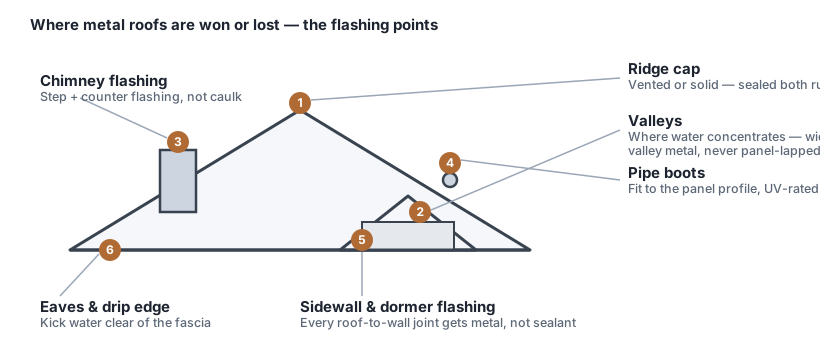
6. Flashing and detail failures — where leaks actually start
When a metal roof actually leaks, the panels are almost never the hole — the chimney, valley, sidewall, and penetration details are. This is true of every roofing material, but metal's longevity raises the stakes: a 50-year panel deserves better than 15-year detail work. It's why we'd rather lose a bid than skip flashing line-items.
The minor-but-real list
- Foot-traffic dents: you can walk a metal roof, but on the right lines — and 29-gauge panels dent where 26-gauge shrugs. HVAC techs are the usual culprits.
- Indoor signal attenuation: a metal roof can weaken cell/radio reception slightly — owners in rural fringe coverage mention it; nobody in town does. (Wi-Fi calling exists.)
- Snow sliding in sheets: a northern-climate issue solved with snow guards; in Augusta it's a once-a-decade curiosity.
- Severe-hail cosmetic denting: impact-rated panels resist puncture impressively (that's the insurance-discount rating), but golf-ball hail can still cosmetically dent any metal. Check whether your policy covers cosmetic damage — some exclude it on metal specifically.
The myths — tested against the evidence
FACT: Lightning strikes the tallest path to ground, not the most conductive roof — strike frequency on metal-roofed homes is no different. And if a strike does happen, a non-combustible metal roof that disperses energy is among the safest surfaces to take it. Industry and insurer literature agree on this one without exception.
FACT: The loud "tin roof" of memory was panels over open rafters in a barn. A residential install goes over solid decking and underlayment with your attic insulation below — measured and reported noise is comparable to shingles. Ask actual owners and rain-noise complaints are conspicuously rare — some say they're disappointed it isn't louder.
FACT: Modern panels are Galvalume — steel metallurgically coated with aluminum-zinc — usually under a factory paint system. Substrate warranties against rupture and perforation run 15–25 years, and real-world service far exceeds them. The honest exceptions: cut edges detailed wrong, dissimilar-metal contact (problem #4 above), and corrosive environments — salt coast, and the ammonia atmosphere of enclosed livestock barns, which most warranties explicitly exclude.
FACT: Backwards. Metal runs roughly 1–1.5 lbs per square foot; architectural shingles run 2.5–4+. It's the lightest mainstream roof there is — which is precisely why over-shingle installation is structurally a non-event.
FACT: This one's sold by the industry, and it's oversold. Standing seam comes close. Exposed-fastener systems have a real (modest) maintenance schedule, and every metal roof wants debris cleared from valleys and a periodic look at its details. "Low maintenance" is true; "no maintenance" is how 40-year roofs get 20-year lives.
FACT: Installers walk them daily — on the panel flats near supports, in soft shoes. The myth survives because the consequence of walking wrong (rib damage, dents on thin gauge) is visible. Tell your HVAC and satellite techs where to step.
When metal is honestly the wrong choice
- Flat roofs. Below about ½/12 pitch, no panel system belongs — that's membrane territory.
- Selling within ~3 years. Resale recoup studies (60–86%) are respectable, but the buyer collects your roof's best decades. Good shingles may pencil better.
- A bargain-bin budget. 29-gauge economy panels from the lowest bidder generate most of metal's bad reputation. If the budget only reaches there, quality architectural shingles are the better roof — a sentence you won't find on our competitors' sites.
- Enclosed livestock confinement without a ventilation plan — see the warranty exclusions above. Talk it through first.
Questions about your specific roof?
Free on-site look anywhere in the CSRA. We'll tell you what fits — including when it's not us.
Call (706) 222-3651 Request an EstimateQuick answers
What is the most common problem with metal roofs?
Fasteners backing out on exposed-fastener (screw-down) systems as panels expand, contract, and UV ages the screw gaskets. It's maintainable — inspection around years 10–15 — and it's the problem standing seam was invented to eliminate.
Do metal roofs leak more than shingles?
No — installed and maintained correctly, they leak less over their life. When they do leak, the cause is overwhelmingly flashing details or aged fasteners, not the panels. The exception: bargain screw-down installs, which leak exactly as often as their fastener maintenance is neglected.
Does hail ruin metal roofs?
Impact-rated (UL 2218 Class 4) panels resist puncture so well that insurers discount premiums for them. Severe hail can still leave cosmetic dents — check whether your policy excludes cosmetic damage on metal before you assume coverage.
Is condensation a problem under metal roofs?
Only in assemblies that ignore it: open-framed barns without vapor management, and roof-overs or insulated buildings without ventilation. It's solved by design — vapor barriers, felt-backed panels, vented air gaps — not by avoiding metal.